EdgevisionAIthatrefusestoguess
Calibrated confidence, auditable decisions, and stated limits, running on affordable edge hardware. One platform, twenty-six use cases. VMS safety intelligence is the first product built on it.
The platform
One platform, twenty-six use cases, one Jetson-class box.
Config-driven detector engines running on affordable edge hardware, engineered and hardened for national-scale transit and public-infrastructure operators.
Use case coverage
Canonical use cases across 11 detector engines, config-driven, not a single-purpose tool.
Edge footprint
One 8GB Jetson-class device runs the whole pipeline. No data-center GPU required.
Engineering bar
Engineered and hardened for national-scale transit and public-infrastructure operators, validated to production-grade edge requirements.
Research systems
Eight research systems, one honesty thesis.Eight research systems, one honesty thesis.
Every number below is measured, not marketed: read off a benchmark run, a test suite, or a dataset card, with the limitation stated next to the result. VMS safety intelligence, further down this page, is one product built on the same platform.
Prompt2Model
A vision-model factory built with a refusal gate instead of a confidence guess.
The compression gate refuses to ship a compressed model that falls below its accuracy floor and keeps the uncompressed one instead; conformal calibration on a pipeline smoke test cut expected calibration error from 0.373 to 0.206.
View the demoFixed-Camera 3D
Recovers metric ground position, speed, and height from a single fixed camera, calibrated from people walking through frame.
Position RMSE 0.16 m at a 5 m, 30-degree mount, to 0.19 m at 8 m, 45 degrees, scored against synthetic ground truth.
View the benchmarkThermal Perception
A thermal-only perception engine that says what it does not know yet.
99 tests green, CPU-only; ships zero trained checkpoints and zero invented accuracy numbers, with the GPU training run costed line by line instead of assumed.
View the benchmarkMulticam Reasoning Memory
Links identities across cameras and remembers them, precision first.
Precision 1.0, recall 0.377 on a synthetic 4-camera, 20-person site, zero wrong merges; the whole site's memory fits in 61,440 bytes.
View the benchmarkAmodal Counting
Counts through occlusion with a calibrated confidence interval, not a guess.
Cuts synthetic MAE from 3.73 to 2.46 at the hardest occlusion density tested, with 90 to 97.5 percent conformal-interval coverage; on real CrowdHuman pedestrian data the correction has not yet beaten the naive baseline, and that gap is published too.
View the benchmarkCausal Predictive Alerting
Predicts an alert seconds before the incident, then grades its own prediction with a falsification ledger.
A 200-scenario battery graded against itself: 63 fulfilled, 87 falsified, 50 no-alert; mean predicted lead time 4.688 s, 8.0 percent false-positive rate on the negative cases.
View the benchmarkEdge Scene Graphs
Detector-agnostic scene graphs with a trained relation head, no VLM required.
0.117 ms mean per batch-64 relation inference on a Jetson Orin Nano Super, TensorRT FP16.
Continual Open-Vocab
Adds new object classes on the box from a text prompt or an image crop, with zero catastrophic forgetting by design.
114 tests passing in under 2 seconds, covering forward-only class learning.
Closed source, open evidence
Dhi's research system code is proprietary. What we publish instead is the evidence: datasets, benchmarks, demos, and whitepapers, so the claims above can be checked rather than taken on faith.
One product on the platform
VMS safety intelligence
The first product shipped on the Dhi platform turns existing CCTV into real-time safety intelligence. It is one offering among the research program above, not the whole company.
Proof, not promises
What DHI's VMS product delivers, before you ever book a demo.
The deployment model, response speed, privacy posture, and operating fit, spelled out up front so you can judge whether DHI fits your environment in minutes.
Deployment model
DHI runs on your current camera estate without forcing a rip-and-replace hardware program.
Latency
Real-time detection and escalation happen at the edge so the alert arrives while operators can still intervene.
Privacy posture
Raw footage stays inside your environment unless you explicitly approve otherwise.
Supported environments
The operating model is designed for rail platforms, depots, warehouses, docks, and high-risk industrial zones.
Measurable outcomes
Teams use DHI to reduce incident-discovery time, surface unsafe behavior earlier, and benchmark pilot performance quickly.
Edge-native architectureEdge-native architecture
Built for speed, privacy, and reliability in harsh environments.
Ingest
Connects to existing RTSP/ONVIF cameras. No new cabling required.
Process
Edge AI processes video locally. <150ms latency per frame.
Protect
Privacy firewall ensures only structured events leave your site.
Alert
Real-time notifications to safety teams via SMS, Email, or API.
See DHI in your environmentSee DHI in your environment
Select an industry to see how our edge AI identifies and prevents specific hazards in real-time.
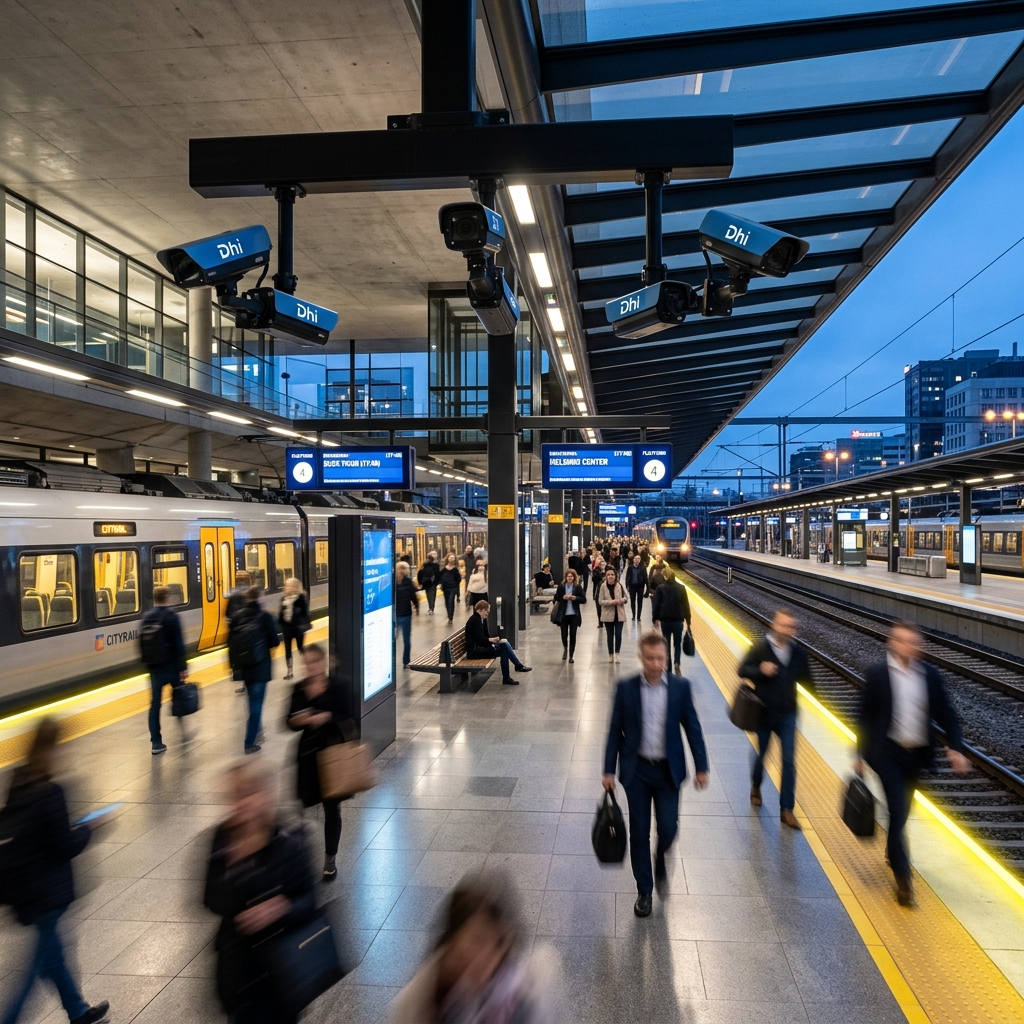
Train Station
Monitor platform edges, track intrusion, and crowd density in real-time.
Active Detections
Why Edge AI?Why Edge AI?
The cloud is too slow for safety. DHI brings intelligence to where the data is generated.
Real-time Latency
Process video in <150ms. Detect incidents as they happen, not hours later.
Offline Capable
Zero dependency on internet bandwidth. Works when the cloud is down.
Privacy First
Raw video never leaves the device. Only structured data is transmitted.
Edge Compute
Runs on NVIDIA Jetson & industrial x86. Optimized for low power.
Decision paths
Move from the homepage into the pages buyers actually evaluate.
DHI is usually evaluated through three lenses: whether edge architecture is necessary, which safety incident comes first, and how the pilot will plug into the current VMS.
Architecture comparisons
High-intent safety use cases
Implementation resources
Deployment-ready infrastructure
DHI is designed for enterprise-grade edge hardware and existing camera, VMS, and alerting systems.
Hardware fit
Designed for NVIDIA AGX Orin, Jetson NX, and industrial x86 edge node classes.
VMS integration
Plug into Genetec, Milestone, Avigilon, and other major video management systems.
Protocol support
Native RTSP and ONVIF support for connecting existing camera streams.
Enterprise integrations
Connect to incident management, ticketing, and SIEM systems via API.
Built for compliance and trust
DHI's architecture is designed to support privacy reviews, security reviews, and operational trust.Raw Video Local • Structured Events • Reviewable Controls
View security detailsContinue Exploring
See how DHI fits warehouse safety
Move from category research into forklift conflict, near-miss detection, fire risk, and aisle-level pilot planning.
Compare edge AI against cloud AI
Review the latency, privacy, and operating tradeoffs before you commit to an architecture path.
Open the pilot planning checklist
Use the implementation checklist that maps category interest into a scoped first deployment.
Read the Dhi Labs whitepapers
The research behind the platform: benchmarks, datasets, demos, and whitepapers for all eight research systems.
Choose the fastest next step.
Move from research into an architecture review, a checklist download, or a real pilot conversation, whichever fits where you are.
Start narrow. You do not need a full estate-wide rollout to validate DHI.
Request a demo
See the flow on a real operating scenario and scope a pilot around one facility or corridor.
See deployment architecture
Review camera ingest, edge inference, alert routing, and what stays on-premises.
Get the implementation checklist
Download the deployment checklist buyers use before green-lighting an industrial AI pilot.
Talk to an engineer
Bring camera count, VMS constraints, latency expectations, and privacy requirements to a technical review.